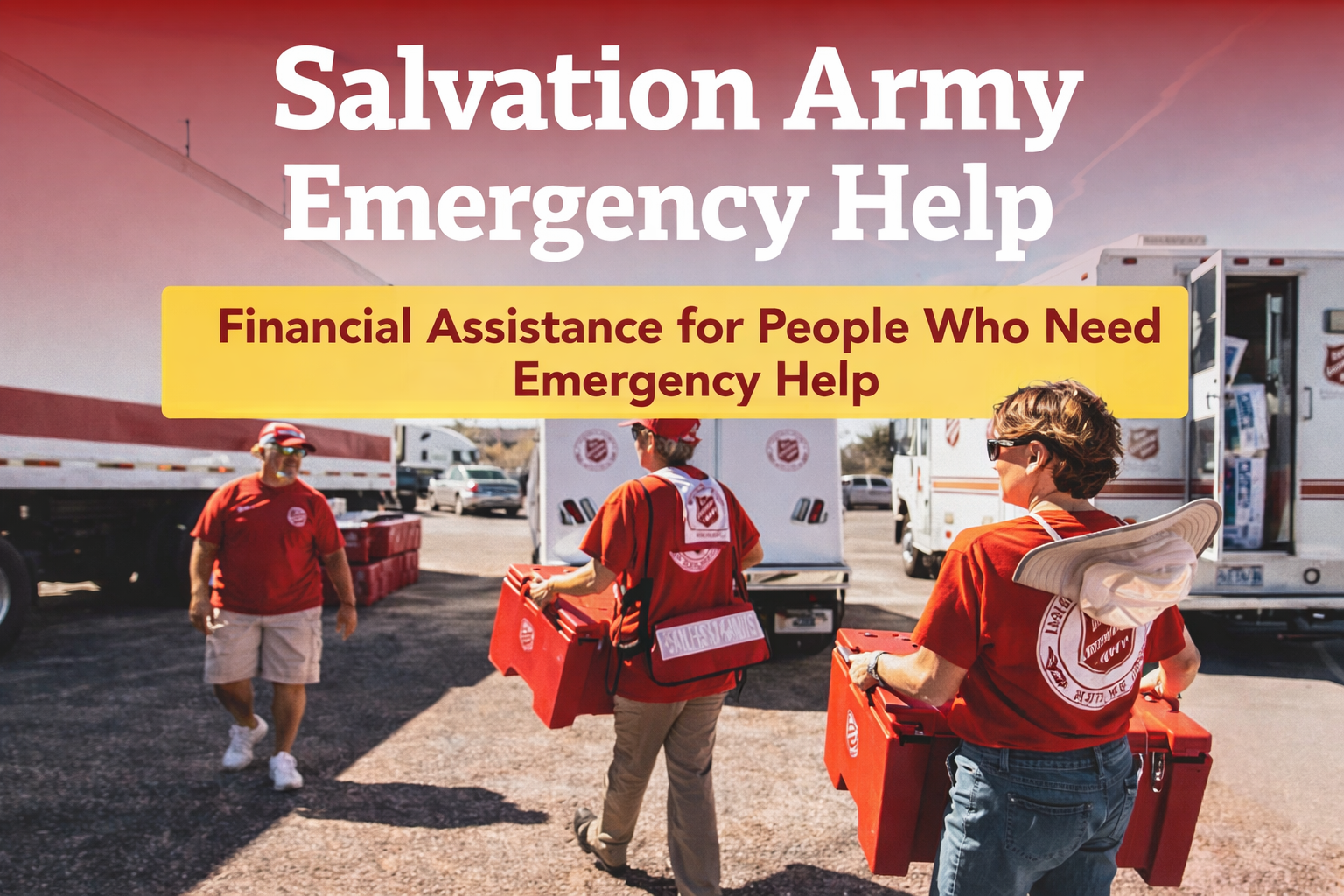
With more than 7,000 service centers across the United States, The Salvation Army provides immediate emergency aid to individuals and families in crisis. Its core services include temporary housing, food banks, and community meals, as well as financial assistance for rent, mortgage, and utility payments. They also provide emergency supplies and emotional support during natural disasters. Since their programs are managed locally, specific availability and eligibility requirements vary by location.
What the Salvation Army offers people who need emergency help
Rent and mortgage assistance
The Salvation Army offers emergency rent and mortgage assistance, helping eligible households facing sudden financial hardship avoid eviction or foreclosure. These local programs make payments directly to landlords or lenders to maintain immediate housing stability. You can enter your zip code directly into the official SAHelp portal to check if your area is currently accepting online emergency applications.
Utility Assistance
The Salvation Army offers emergency utility assistance, helping low-income individuals, seniors, and families in immediate financial crisis keep their electricity, gas, and water services connected. They typically step in during extreme weather conditions (when bills spike) or when the applicant has received an official disconnection notice.
Most local centers require an initial appointment, either in person or by phone. To receive utility assistance, you generally need to provide a disconnection notice, proof of financial hardship, income documentation, official photo ID for adults, and birth certificates or Social Security cards for children in the household. There are also options managed directly by utility companies; many of these are detailed in the section of the website dedicated to utility company assistance programs.
Transportation Assistance: Emergency Gas or Bus Vouchers
The Salvation Army provides emergency transportation assistance through local bus passes, tokens, or gas cards. This aid is strictly intended for essential local travel, such as attending a job interview, commuting to a new job before receiving the first paycheck, or going to confirmed medical appointments. If requesting gas assistance, you must present a valid driver’s license, current vehicle registration, and proof of active car insurance.
Generally, the vehicle must be registered in the applicant’s name. You can enter your zip code into the national SAHelp portal to locate the nearest Family Services office. Since transportation funds are very limited and rely on local donations, availability varies significantly depending on the organization’s local center. Additionally, consult the guide on the Salvation Army’s vehicle programs to learn about the available options and how these programs typically operate.
Prescription and medical assistance
The Salvation Army offers medical and emergency medication assistance to help uninsured, underinsured, or low-income individuals afford life-saving medications and basic medical equipment. This aid is typically designed as a short-term safety net to cover critical, immediate health needs—such as antibiotics or insulin—during a financial crisis. Assistance is generally limited to life-saving medications or those for acute conditions (e.g., insulin, heart medication, asthma inhalers, or short-term antibiotics).
Funds are usually restricted to a one-time emergency supply (such as a 30-day provision) while social workers help you transition to a long-term patient assistance program. Enter your location on the official SAHelp portal to check if your local Salvation Army center offers active assistance in the form of vouchers for medication or medical services.
Short-term housing and shelter for the homeless
The Salvation Army operates immediate emergency shelters and short-term transitional housing for individuals, families, veterans, and survivors of domestic violence. These facilities provide a safe bed, hot meals, climate-controlled shelter, hygiene supplies, and social workers dedicated to helping residents transition to permanent housing.
Immediate short-term housing offering a safe bed, showers, laundry facilities, and hot meals, available on a nightly or short-term basis.
Emergency shelters provide immediate, temporary refuge for individuals and families who suddenly become homeless or are escaping dangerous situations.
Subsidized rental housing combined with ongoing, voluntary support services, such as case management with home visits, mental health counseling, and healthcare coordination.
Since housing programs operate via waiting lists or coordinated entry systems, you cannot directly access transitional or permanent supportive housing; you must first undergo an intake assessment.
Use the national SAHelp portal to check current program availability. For programs that go beyond what a local center offers, the site’s general guide to the Salvation Army’s hotel and motel voucher programs provides more information about this resource.
Free food, groceries, and meals – food pantries and soup kitchens
The Salvation Army operates free food pantries, soup kitchens, and mobile feeding programs to ensure that individuals and families facing economic hardship or homelessness have regular access to nutritious food.
Emergency food distribution centers where individuals and families receive free food boxes containing non-perishable staples, fresh fruits and vegetables, meat, and dairy products (availability varies based on supply).
Soup kitchens and community meal centers offering hot, sit-down breakfasts, lunches, or dinners to anyone in need, without requiring background checks. They also operate mobile feeding units that travel to specific street locations or encampments to deliver hot meals, water, and snacks directly to people experiencing homelessness.
Employment assistance and self-sufficiency programs
The Salvation Army offers employment assistance and comprehensive self-sufficiency programs designed to help individuals break the cycle of generational poverty and achieve long-term financial independence. Going beyond temporary relief, these initiatives combine job training with intensive, multi-month case management to foster lasting stability.
The Pathway of Hope program is The Salvation Army’s flagship national case management system, targeting families with children under 18 who are trapped in chronic poverty. Participants are assigned a dedicated caseworker who monitors their progress through regular, one-on-one goal-setting meetings. Case managers work systematically to overcome specific barriers to employment, such as a lack of local transportation or housing instability.
Seasonal programs for families and children
The Salvation Army runs specialized seasonal programs to support low-income families and children during critical times of the year, such as the start of the school year and the holiday season. These programs aim to alleviate financial pressure on parents, allowing them to focus on maintaining basic household stability.
The Salvation Army’s “Angel Tree” program is its best-known Christmas initiative; it provides new clothing and toys to millions of children who might otherwise not receive gifts. Parents register their children (typically aged 0 to 12) and specify clothing sizes and the particular toys the children would like. These “angels” are placed on trees at local businesses or listed online so community members can “adopt” them and fulfill the children’s wishes. Registration generally opens in September or October each year. Spots fill up quickly, and late registrations are rarely accepted.
Back-to-school assistance ensures children start the academic year well-prepared; local Salvation Army centers provide essential school supplies. Depending on local funding and school district requirements, some centers offer vouchers for school clothes or gift cards to purchase sturdy school shoes.
Most centers offer special meals during Thanksgiving and Christmas; these are free hot meals open to anyone in need, and home delivery is sometimes arranged for seniors with limited mobility who cannot leave their homes.
Summer camps and after-school programs for children
After-school programs managed directly by local community centers, these programs cover the time between the end of the school day and when parents return from work. They operate Monday through Friday and strictly follow the local school district’s holiday and closure schedule.
Summer day camps: When school ends for the summer, local centers switch to offering full-day care options, allowing parents to maintain their work schedules without facing excessive childcare costs. Participants engage in structured activities, including active games, summer Bible programs, crafts, field trips, and team sports. These camps are typically free or low-cost. Most centers accept state child care subsidies and offer internal scholarships with income-adjusted rates for families experiencing documented financial hardship.
Disaster assistance – emergency help for people impacted
The Salvation Army provides emergency disaster assistance to individuals, families, and communities affected by natural disasters and other large-scale emergencies.
Finally, there are programs that go beyond emergency aid
Income-based housing for seniors consists of independent living facilities for low-income older adults and people with physical disabilities; these are primarily funded through Section 202 subsidies from HUD (the U.S. Department of Housing and Urban Development). Generally, the head of the household must be 62 years of age or older (or an adult requiring the physical features of an accessible apartment) and meet strict low-income limits defined by HUD for that specific county.
The Adult Rehabilitation Center program is a free, six-month residential substance abuse recovery initiative for men and women seeking to overcome drug and alcohol dependency. Applicants must be at least 21 years old (age requirements vary slightly by state), possess valid photo identification, pass breathalyzer and drug screening tests upon arrival, and be physically able to participate in the daily schedule of work therapy.
Kroc Centers are large, state-of-the-art community recreation and education facilities funded by a historic multi-million dollar donation from Joan Kroc (widow of McDonald’s founder Ray Kroc). These centers offer highly subsidized “Kroc Scholarships” to low-income individuals and families, reducing membership fees to a nominal, affordable amount following income verification.
Select your state below to learn more about The Salvation Army and find links to social service centers in your community. The Salvation Army’s national location finder tool, available at https://www.salvationarmyusa.org/location-finder/, can also help you locate the nearest service center.
Alabama
Alaska
Arizona
Arkansas
California
Colorado
Connecticut
Delaware
District of Columbia
Florida
Georgia
Hawaii
Honolulu County
Idaho
Illinois
Indiana
Iowa
Kansas
Kentucky
Louisiana
Maine
Maryland
Massachusetts
Michigan
Minnesota
Mississippi
Missouri
Montana
Nebraska
Nevada
New Hampshire
New Jersey
New Mexico
New York
North Carolina
North Dakota
Ohio
Oklahoma
Oregon
Pennsylvania
Rhode Island
South Carolina
South Dakota
Tennessee
Texas
Utah
Vermont
Virginia
Washington
West Virginia
Wisconsin
