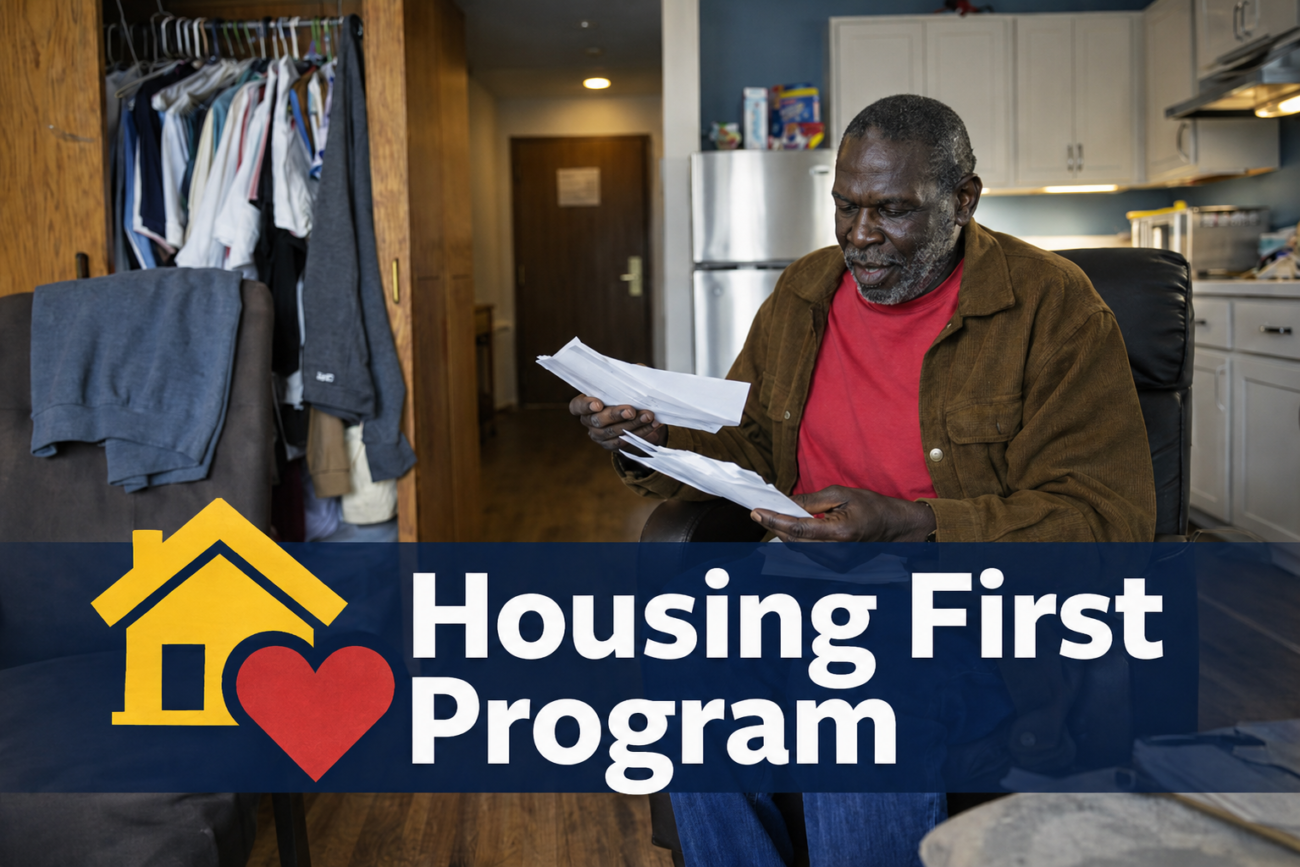
A rental assistance program based on the Housing First model provides immediate, permanent housing to homeless individuals or families, without prerequisites or conditions such as sobriety, mental health treatment, or a clean criminal record. This model is based on the principle that people are better able to address secondary challenges (such as substance use or unemployment) once they have a safe, stable place to live.
Categories of Housing First Programs
Programs utilizing the Housing First approach generally fall into two main service models, in addition to a broader system-level category.
1. Permanent Supportive Housing (PSH)
This model is designed for individuals experiencing chronic, long-term homelessness who often face complex, co-occurring challenges, such as physical disabilities, mental health issues, or substance use disorders.
Duration: Permanent, long-term housing with no time limit. Subsidy: Ongoing rental assistance, with tenants typically contributing 30% of their income toward rent.
Services: Comprehensive, intensive, lifelong services (case management, medical care, therapy) are provided either on-site or in the community.
Structure: Can be “project-based” (units within a single building dedicated to this purpose) or “tenant-based” (vouchers used with private landlords in the community).
2. Rapid Re-Housing (RRH)
This model focuses on individuals and families experiencing temporary homelessness due to a sudden financial setback, eviction, or personal crisis.
Duration: Short- to medium-term assistance, typically lasting between 3 and 24 months.
Subsidy: Financial aid that gradually decreases as the household stabilizes and income increases.
Services: Moderate-intensity case management focused on housing searches, budget planning, and connecting tenants with employment or long-term community resources.
Structure: Almost exclusively tenant-based; helps individuals find conventional apartments in the private rental market.
3. Coordinated Entry Systems (System-level category)
While not a direct housing voucher, this is the operational category that connects individuals with PSH and RRH programs.
Purpose: A centralized, community-wide process to assess and prioritize individuals based on their level of vulnerability.
Function: It ensures that individuals with the greatest needs are assigned to Permanent Supportive Housing, while those with fewer barriers are referred to Rapid Re-housing programs.
How rental assistance works
Rental assistance under the Housing First model works by removing barriers to access and operating like a conventional market-rate lease, backed by a financial subsidy.
The Application and Move-In Process
No preconditions: Applicants do not need to pass drug tests, demonstrate sobriety, prove income, or have a clean criminal record to qualify. Immediate placement: The goal is to move the individual or family from shelters or the street into their own housing as soon as possible.
Standard lease agreement: Participants sign a standard, legally binding lease directly with the landlord. They have exactly the same legal rights and responsibilities as any other private-sector tenant.
Financial subsidy and rent structure
Income-based contributions: The Housing First program is rarely “free” in the long run. If a tenant has income (such as SSI, disability benefits, or employment earnings), they must pay a fixed percentage—usually capped at 30% of their adjusted monthly income—directly toward the rent.
Program coverage: The rental assistance program subsidizes the remaining 70% of the cost, paying the landlord directly each month.
Housing for those with no income: If a participant enters the program with no income ($0), the program pays 100% of the rent until the individual stabilizes and begins receiving financial benefits or finds employment.
Landlord relationships and risk mitigation
Private market partnerships: Programs actively seek out private landlords, guaranteeing that the government or agency portion of the rent will always be paid on time.
Mitigation funds: Many programs offer “landlord mitigation funds.” These are special financial reserves designed to reimburse landlords for property damage or unpaid rent, thereby reducing the landlord’s financial risk.
Voluntary services and eviction rules
Independent services: Although comprehensive support services (addiction counseling, therapy, medical care, job training) are widely available, participation is strictly voluntary.
Evictions based on the lease agreement: A tenant cannot be evicted for refusing treatment, missing therapy, or experiencing a relapse. However, they can be evicted for standard lease violations, such as property damage, illegal activity on the premises, or disturbing the peace.
How to access assistance
To access Housing First rental assistance, you must go through your county or city’s centralized assessment process rather than applying directly at specific buildings.
Since Housing First receives federal funding from the U.S. Department of Housing and Urban Development (HUD) but is managed locally, the point of access depends entirely on where you live.
Step 1: Contact Your Local Coordinated Entry System
Most communities use a centralized system called Coordinated Entry (CE) to assess, prioritize, and connect individuals with Housing First programs, such as Permanent Supportive Housing or Rapid Re-housing.
Call 211: Dialing 2-1-1 from any phone is the fastest way to find your local housing assessment center. This call connects you with a community resource specialist who can provide the exact address and phone number of the nearest access point.
Find your Continuum of Care (CoC): HUD (Department of Housing and Urban Development) divides the country into local networks called “Continua of Care” (CoCs). You can search for your local network using HUD’s official CoC contact search tool to locate the agency that manages housing vouchers in your area.
Step 2: Complete the vulnerability assessment
Once you contact a Coordinated Entry center, a caseworker will conduct a standardized interview (often using a tool called the VI-SPDAT).
Goal: This assessment does not disqualify you for having problems; rather, it measures your level of need.
Prioritization: Under the Housing First model, priority is given to the most vulnerable individuals—such as those with chronic illnesses, disabilities, or long histories of homelessness—placing them at the top of the waiting list for immediate housing.
Step 3: Gather essential documentation
Although Housing First programs do not require sobriety or employment, local housing authorities require identification to process standard lease agreements. While waiting for a housing assignment, try to gather the following:
- Government-issued photo ID
- Social Security cards for all household members
- Children’s birth certificates
- Proof of income (such as an SSI award letter, pay stubs, or a formal statement verifying no income)
Specific alternative access points
If you or the person you are assisting belongs to a specific demographic group, there may be faster pathways to specialized housing:
For veterans: Contact the nearest VA (Veterans Affairs) Medical Center or call the National Call Center for Homeless Veterans at 1-877-4AID-VET (1-877-424-3838) to inquire about the HUD-VASH program, which explicitly uses the Housing First approach.
For families with children: Contact local family shelters or your public school district’s McKinney-Vento homeless program coordinator; they can expedite referrals to the Coordinated Entry system.
For youth (ages 18–24): Look for youth-specific service centers, which often manage independent rapid re-housing programs tailored to young adults.
