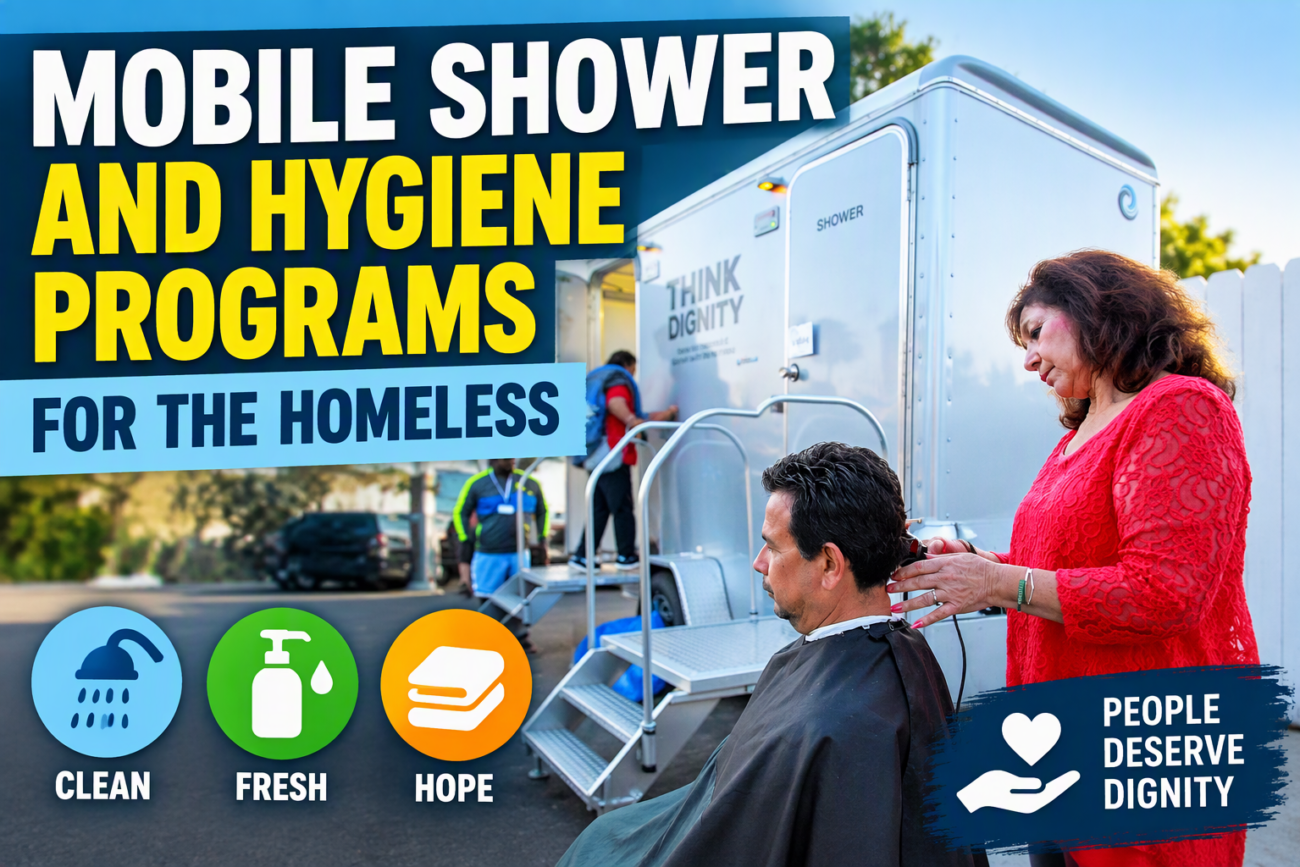
Mobile shower and hygiene programs in the United States provide essential water, sanitation, and hygiene (WASH) services that restore personal dignity, improve health, and serve as a vital bridge to housing and social services. Beyond functioning merely as emergency facilities, these programs collaborate with local churches, community centers, and outreach-based healthcare teams to offer a comprehensive support network.
If you would like to find a mobile shower event, volunteer, or partner with an organization, there are several prominent programs—operating at both national and regional levels—that lead these initiatives.
Major Mobile Shower Organizations in the U.S.
ShowerUp
ShowerUp is a non-profit organization that operates mobile shower, laundry, and personal care units for individuals experiencing homelessness. Their fully self-contained trailers are equipped with private, lockable shower stalls, hot water, sinks, and laundry facilities.
Locations and Schedules
ShowerUp operates in various cities across the United States. You can view updated schedules and specific operating hours for each city directly through the ShowerUp scheduling page:
- Tennessee: Schedules for Nashville, Chattanooga, Memphis, and Cookeville
- Illinois: Schedules for Chicago and Aurora
- Alabama: Schedule for Huntsville
- Kansas: Schedule for Wichita
- Florida: Tampa Bay, St. Petersburg, and Clearwater
- South Carolina: Columbia
Disaster Relief Services
In addition to their regular city schedules, ShowerUp deploys mobile trailers to provide emergency hygiene services during natural disasters. They offer essential assistance—such as drinking water, mobile showers, and laundry facilities—in the wake of hurricanes, tornadoes, wildfires, floods, and ice storms. How to Participate
Since the program relies almost entirely on local communities to function, there are several ways to get involved:
Volunteering: Volunteers assist by welcoming users, distributing hygiene kits, preparing the trailers, or driving the units. You can sign up through the ShowerUp volunteer portal.
Donating Supplies: The units are in constant need of donations of new, travel-sized hygiene items—such as body wash, shampoo, toothbrushes, toothpaste, and deodorant—as well as clean socks.
The Shower of Hope
The Shower of Hope is a non-profit organization that provides mobile hygiene services and essential, comprehensive care to people experiencing homelessness throughout Los Angeles County, California. Its mission focuses on restoring dignity and community ties by combining hot showers with meals, clean clothing, and direct pathways to housing and support services.
Current Schedule and Main Locations
Because the locations of the mobile units may vary based on the availability of local partner organizations, we recommend checking the daily updated routes on “The Shower of Hope” schedule page.
Active service sites, which are part of their weekly routes, include:
- Boyle Heights: Located at Clínica Romero (2032 Marengo St).
- Lincoln Park: Operating near 3501 Valley Blvd.
- North Hollywood: Functions as a “Shower Stop” at St. Matthew’s Lutheran Church (11031 Camarillo St).
- Skid Row / Downtown Los Angeles: Present at several key locations, including the Downtown Mental Health Center (529 Maple Ave) and the intersection of 6th and Wall Streets.
Cypress Park and Studio City: Partner sites that offer expanded weekly services.
Comprehensive Care Programs
The organization goes beyond providing access to water and sanitation by creating a support ecosystem:
Comprehensive Resources: While waiting for their turn to shower, individuals can access nutritious food, hygiene kits, clean socks and underwear, and legal assistance.
Safe Parking Programs: In specific neighborhoods, such as Westlake/Pico-Union and Glassell Park, they manage designated spaces where people experiencing homelessness who live in their vehicles can park safely and under supervision overnight.
Housing Access Guidance: On-site teams connect individuals with case managers from local partner organizations, who provide guidance on finding housing solutions—whether transitional or permanent.
How to Support the Mission
You can contribute directly through The Shower of Hope’s official website:
Volunteering: Volunteers assist with registration, managing waitlists, and preparing hygiene kits at active mobile sites.
Donations: Financial contributions and the donation of new hygiene items (travel-sized shampoo, soap, toothbrushes, and new socks) directly fund operations.
Fresh Start WASH & Wellness
Fresh Start WASH & Wellness is a specialized mobile infrastructure program developed by Clean the World (through its non-profit entity, The WASH Foundation).
What distinguishes this program from other mobile shower units is its dual focus: it functions both as a sanitation hub—providing water, sanitation, and hygiene (WASH) services—and as an accessible, immediate healthcare unit (wellness).
Regional Deployment
The program operates on fixed weekly routes using heavy-duty trailers designed specifically for this purpose. You can track active, specific routes and download regional schedules directly via The WASH Foundation’s Resource Portal:
- California: Active operational hubs in Chula Vista and Tulare County.
- Nevada: Serving unhoused communities throughout Clark County (the Las Vegas region).
- Florida: Active routes in the Orange County area (including collaborations in Orlando).
- Washington: Multi-stop services in King County (Seattle metropolitan area).
- Colorado: Targeted deployments in the city of Aurora.
Services offered in the mobile units
The mobile units—self-contained trailers—travel directly to areas where individuals experiencing homelessness tend to congregate, providing a range of on-site services:
Essential hygiene items: Private, temperature-controlled shower stalls, stocked with clean towels and hygiene kits provided by the organization Clean the World.
Direct medical care: Basic clinical services, typically including preventive care, guidance on managing health conditions, rapid diagnostic testing, and access to essential vaccines (such as those for hepatitis A, B, and C, and COVID-19).
Basic necessities: Distribution of hot meals, access to drinking water, and clothing exchanges, facilitated through partnerships with day-service centers.
Resource navigation (support): Field staff actively connect individuals with available local municipal resources, such as detoxification programs, job training networks, and agencies dedicated to rapid, permanent rehousing.
WeHOPE – Dignity on Wheels
WeHOPE’s Dignity on Wheels (DoW) program is a highly specialized initiative that provides mobile hygiene and support services throughout the San Francisco Bay Area, California. Launched in 2015, the program addresses the systemic barriers faced by people experiencing homelessness by bringing essential resources directly to encampments, parking areas, and community spaces.
Service areas and updated schedule
The Dignity on Wheels fleet regularly travels across 5 counties and 20 cities throughout the Bay Area, prioritizing high-need areas in San Mateo, Santa Clara, Alameda, and Marin counties. Since locations change daily to cover an extensive territory, you can check the most up-to-date schedule via the official WeHOPE DoW Live Route Schedule.
Regular partner locations include:
- San Jose / Santa Clara County: Deployments at Martha’s Kitchen, Backesto Park, Marsalli Park, and various local encampments.
- Redwood City / San Mateo County: Services located at the Fair Oaks Community Center and the Redwood City Library.
- Oakland / Alameda County: Operations at municipal temporary housing sites (cabin-style), including Mandela Community Cabins and Northgate Community Cabins.
Services and Guidelines for the Trailers
To serve as many people as possible, as efficiently as possible, during each 4-hour operational session, the trailers—which are self-contained units—operate under a specific structure:
Hot Showers: Users are allotted a total of 15 minutes in a private, ADA-accessible space, which includes a hot shower with a 7-minute time limit. Clean towels, bath mats, and body soap are provided.
Mobile Laundry: Washers and dryers are available on-site. To maximize capacity, laundry use is generally limited to 1 or 2 pairs of pants, approximately 3 t-shirts, socks, and undergarments per person.
Intake Process: Services are provided on a first-come, first-served basis. First-time users are asked to complete a brief user profile form and sign a standard liability waiver.
Advanced Medical & Tech Support
Unlike traditional emergency trailers, WeHOPE incorporates specialized infrastructure to deliver vital medical and technological resources directly to where people are located:
Virtual medical assessments: Through a unique medical-humanitarian partnership with the Stanford School of Medicine, the trailers enable individuals experiencing homelessness to consult remotely with doctors and healthcare professionals.
Power and connectivity: The units serve as community power hubs, providing secure internet access and charging stations for personal devices, allowing users to stay in touch with their families, social workers, or potential employers.
Case management: Field staff conduct an immediate initial assessment to connect users with services such as permanent housing assistance, nutrition programs, and job training—all managed through WeHOPE’s primary program portal.
Streetside Showers
Streetside Showers is a non-profit organization, founded in 2017, with a mission to restore hope and human dignity to those experiencing homelessness by providing mobile hot-water showers, clean clothing, and personal hygiene items.
The organization operates specialized trailers that function as fully private restrooms, where users can shower, shave, brush their teeth, and use a clean toilet. Over time, they have expanded their services to include the “Streetside Closets” program—which provides new socks, underwear, and other clothing—as well as laundry trailers designed to help users wash their uniforms and work attire.
The program operates on a first-come, first-served basis, with various locations across key areas in Texas and Florida.
What can you expect at a mobile shower event?
Although specific services may vary slightly depending on the configuration of each trailer, mobile hygiene events follow a dignified and predictable routine:
Waiting list: Upon arrival, users sign up for a “shower list” managed by staff or volunteers.
Hygiene kits: When a private stall becomes available, users receive a clean towel, a washcloth, and a hygiene kit containing soap, shampoo, conditioner, a toothbrush, toothpaste, and deodorant.
Personal items: Many providers offer new undergarments (clean socks and underwear) and the option to exchange clothing items.
Accessibility: Modern units often include trailers that are ADA-compliant (Americans with Disabilities Act), equipped with access ramps for individuals with limited mobility.
Find a list of counties or cities in the United States where free mobile shower services are available.
Free mobile shower and hygiene programs for people experiencing homelessness operate primarily through non-profit organizations, municipally funded initiatives, and regional networks. Because these programs are mobile, services are typically offered at various locations—such as parks, resource centers, or church parking lots—on different days of the week.
A detailed list, organized by state, identifies major cities and counties across the United States where free mobile shower services are currently available:
Alabama
Huntsville / Madison County: Mobile hygiene units and the distribution of clean clothing are coordinated on a regular basis through ShowerUp Huntsville.
California
Los Angeles County: This area has one of the most extensive networks of mobile shower units in the country. Frequent operations take place every week at various locations throughout the city of Los Angeles (Skid Row, Boyle Heights, Hollywood, Venice Beach, East LA), as well as in Pasadena and Inglewood, thanks to organizations like The Shower of Hope and mobile health partnerships within Los Angeles County.
San Francisco Bay Area (5-county region): More than 20 cities across Santa Clara, San Mateo, Alameda, San Francisco, and Contra Costa counties—including urban centers like San Jose—receive structured services through WeHOPE’s “Dignity on Wheels” fleet.
Sacramento County: Mobile shower trailers, managed by the municipality and various non-profit organizations, operate periodically in the cities of Sacramento and Elk Grove.
San Diego County: Mobile health and hygiene fleets deploy units in downtown San Diego and North County, with additional services also scheduled for Chula Vista.
Tulare County: Regional teams serving agricultural communities deploy mobile trailers to rural settlements.
Colorado
Aurora / Arapahoe County: Trailers that integrate medical and hygiene services are deployed through the WASH Foundation’s “Fresh Start” program.
Denver: Local non-profit street outreach teams deploy trailers equipped with multiple shower stalls in areas near shelters that are operating at or near capacity.
Florida
Orlando / Orange County: Advanced mobile trailers—outfitted with multiple shower stalls—serve as a base for healthcare initiatives aimed at individuals experiencing homelessness. Tampa Bay (Tampa and St. Petersburg): Mobile units operate through regional faith-based networks and the organization ShowerUp.
Illinois
Chicago / Cook County: ShowerUp Chicago provides mobile shower units year-round (including climate-controlled trailers for the winter season).
Kansas
Wichita / Sedgwick County: Mobile units make scheduled stops in coordination with local day centers, ensuring consistent access to hygiene services.
Nevada
Las Vegas / Clark County: High-capacity mobile trailers provide service in the historic Westside area and the surrounding desert corridor.
South Carolina
Columbia / Richland County: Mobile shower units are deployed directly alongside soup kitchens and clothing distribution centers.
Tennessee
Nashville / Davidson County: The founding headquarters of ShowerUp, which operates several mobile units (trucks with trailers) that follow fixed weekly routes throughout the city.
Chattanooga / Hamilton County: Mobile trailers provide service at encampments and city-authorized resource zones.
Memphis / Shelby County: Mobile hygiene units operate in the metropolitan area of the city center.
Texas
Dallas-Fort Worth Metropolitan Area: Extensive regional coverage is provided by CleanUP USA (which operates private, 6-stall units throughout the area) and Cloud Covered Streets (which offers shower, laundry, and haircut services in Fort Worth and Arlington).
Austin / Travis County: Mobile hygiene initiatives operate in the city center through partnerships with local support organizations.
Houston / Harris County: Municipal street outreach teams utilize fleets of mobile trailers to provide services in locations lacking access to basic amenities, while also incorporating case management.
Washington
Seattle / King County: Specialized hygiene trailers visit various urban settlements and established encampments.
