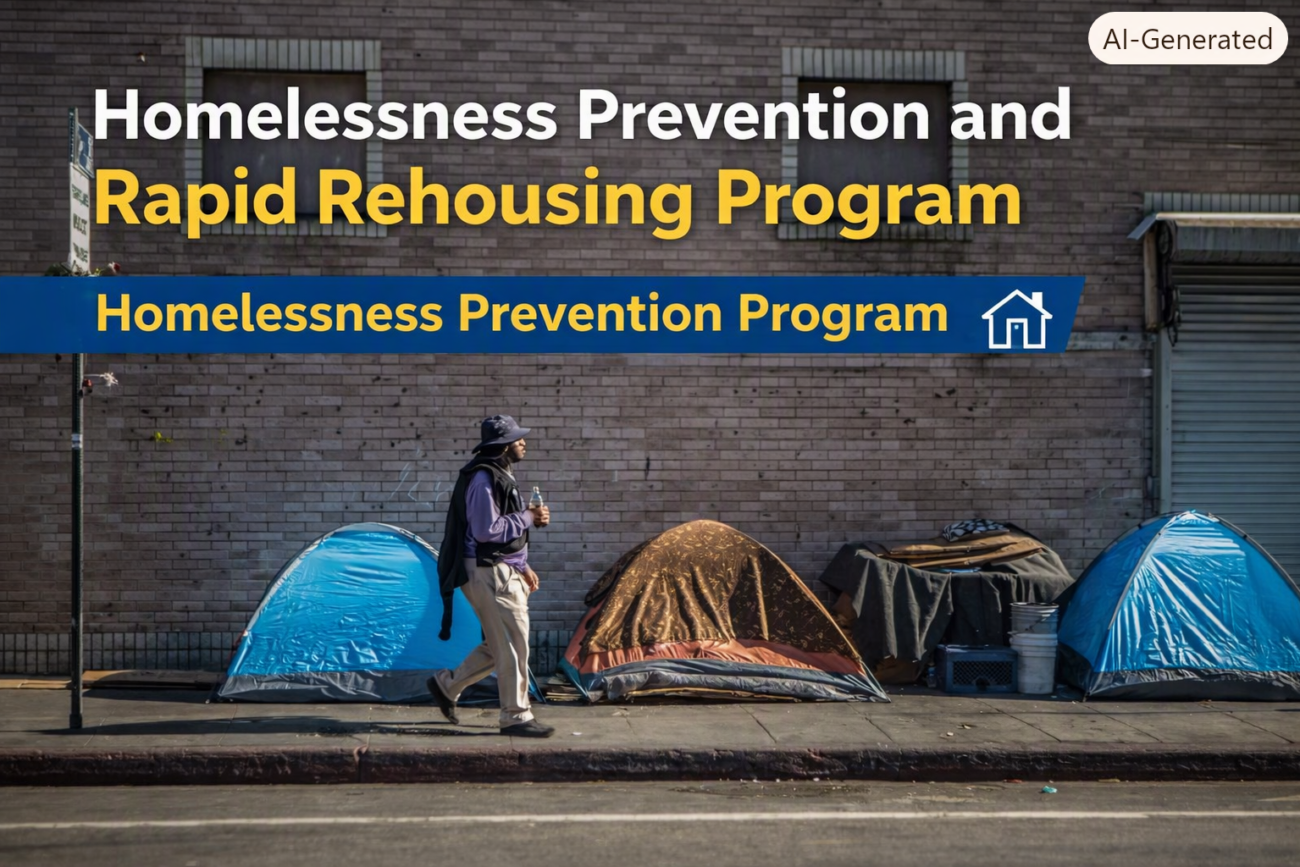
The Homelessness Prevention and Rapid Re-Housing Program (HPRP) was a federal program established by the American Recovery and Reinvestment Act of 2009 to help individuals and families avoid homelessness or quickly return to permanent housing. Although the original HPRP funds have been exhausted, many of its services continue today through HUD’s Emergency Solutions Grants (ESG) program and local Continuum of Care (CoC) programs. These programs offer rental assistance, housing stabilization services, and case management, using similar eligibility criteria.
To request access to a homelessness prevention and rapid re-housing program, you must contact your local Continuum of Care (CoC) intake center, call 2-1-1, or visit a designated coordinated entry point.
Type of financial help offered by Homeless Prevention – Rehousing Programs
Homelessness prevention and Rapid Re-Housing (RRH) programs offer financial assistance to help households retain their current housing or quickly move into a new permanent home.
Short-term rental assistance: Full or partial rent payment for a period of up to 3 months.
Medium-term rental assistance: Full or partial rent payment for a period of 4 to 24 months.
Rental arrears: One-time payment of up to 6 months of past-due rent to halt an ongoing eviction process.
Security deposits: Funds to cover the initial deposit required by a new landlord.
Utility deposits: Payment to set up new gas, electric, water, or sewer services. Utility arrears: Payment of up to 6 months of overdue utility bills to prevent service disconnection.
Moving expense assistance: Financial aid for truck rentals or professional moving services.
Financial aid for housing stabilization services
Application fees: Payments to cover background and credit check costs for potential housing.
Legal services: Funds for attorneys to resolve tenant-landlord disputes or to provide a defense against eviction in court.
Credit repair: Financial counseling services to resolve debt and improve rental eligibility.
Step-by-Step Application Process
To request homelessness prevention or Rapid Re-Housing assistance, you must complete a multi-step process managed by your local Continuum of Care (CoC) network. Because funding is local, you cannot apply through a single national website.
Step 1: Contact your local CoC center
Call 2-1-1: Dial 2-1-1 from any phone. This is the fastest way to reach your area’s housing crisis hotline.
Locate a CoC center: Use HUD’s online CoC contact directory to find the specific agency managing funds in your county.
In-person visit: Go to a designated local “Coordinated Entry” center; these may be located at county social services offices, municipal housing departments, or major local non-profits (such as the Salvation Army or Catholic Charities).
Step 2: Complete the Coordinated Entry assessment
Initial assessment: An intake worker will interview you using a standardized assessment tool (often called the VI-SPDAT).
Prioritization (Triage): The tool assigns a score to your household based on vulnerability, health factors, and risk of immediate harm.
Referral: Based on your score, you will be placed on a centralized local priority list. Households with the highest vulnerability are the first to be assigned to available program openings.
Step 3: Gather and submit required documentation
You must provide documentation to verify your eligibility. Gather the following documents immediately:
Identification: Government-issued photo ID for all adults, and birth certificates or Social Security cards for minors.
Proof of income: Recent pay stubs, tax returns, child support records, or benefit award letters (SSI, SSDI, TANF, SNAP). If you have no income, you must sign a self-certification form.
Proof of crisis (for prevention): An official written eviction notice from your landlord, a utility shut-off notice, or a court summons related to rent.
Proof of homelessness (for rapid re-housing): A formal verification letter from an emergency shelter manager or street outreach worker confirming that you are staying in a place not fit for human habitation.
Lease agreement: A copy of your current rental agreement (for prevention) or a proposed lease agreement (for re-housing).
Step 4: Working with an assigned case manager
Housing search: If you are assigned to the Rapid Re-Housing program, your case manager will help you identify landlords who rent at market rates and accept program funds and tenant background checks.
Inspection: The agency must inspect the apartment to ensure it meets HUD’s Housing Quality Standards (HQS) regarding safety and habitability.
Rent reasonableness: The agency will conduct a market check to ensure the landlord is not charging a price higher than that of comparable units in the area.
Step 5: Signing the lease and the subsidy agreement
Signing the lease: You will sign a standard lease agreement directly with the landlord. The program does not act as a guarantor, and the lease is in your name.
Rental assistance agreement: You, the landlord, and the agency will sign a three-party agreement detailing exactly what percentage of the rent the agency will pay and what percentage you will pay.
Stabilization: You will begin mandatory monthly reviews to create a budget, set employment goals, and make a gradual transition to paying the full rent on your own.
Ongoing program requirements
If your application is approved, the local agency will generally require you to meet with an assigned caseworker at least once a month. You will also need to complete periodic financial recertification paperwork to assess whether you still require a partial rent subsidy.
