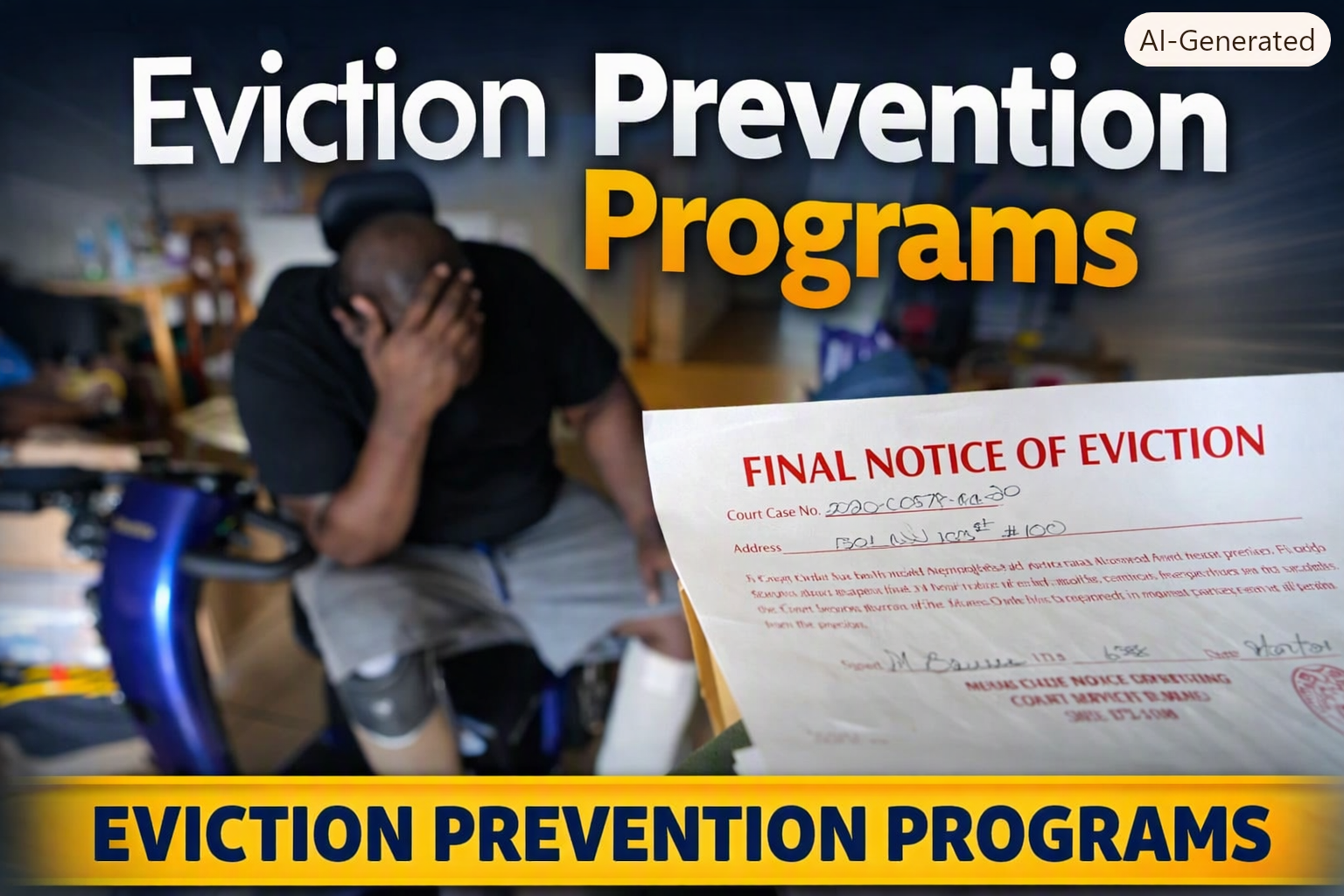
Eviction prevention programs offer immediate financial assistance, emergency legal aid, and mediation services to help tenants resolve disputes, pay overdue rent, and maintain stable housing. Since these initiatives are typically administered at the state, county, or municipal level, the resources available to you depend entirely on your geographic location.
If you are facing ongoing eviction proceedings or falling behind on payments, you can use the guide below to find local help and learn about the protection options available to you.
What eviction prevention programs in your area offer
Eviction prevention programs offer three main types of support to help tenants keep their homes: emergency financial assistance, free legal protection, and case management. These services work together to settle outstanding rent debts, halt formal court proceedings, and foster long-term housing stability.
Depending on the local agency or non-profit organization distributing the funds, tenants may access various specific forms of assistance.
Emergency financial assistance
Financial aid is generally paid directly to landlords or utility companies to settle immediate housing-related debts:
Past-due rent: Cash grants covering several months of overdue rent to clear the tenant’s debt.
Future rent: Short-term aid to pay rent for the upcoming 1 to 3 months while the tenant regains their income.
Utility payments: Emergency funds to settle overdue electricity, gas, water, or internet bills and prevent service shutoffs.
Late fees and legal costs: Coverage for administrative late fees or court filing costs charged by the landlord.
Relocation costs: Funds for security deposits, the first month’s rent, or moving truck expenses, in cases where moving to a more affordable apartment is the only option.
Legal Defense & Mediation Services
These programs help tenants navigate the complex eviction court system and protect their consumer rights:
Pro bono representation: Lawyers who offer their services for free to represent low-income tenants during formal eviction hearings.
Landlord mediation: Impartial negotiators who help landlords and tenants establish a realistic payment plan without the need for court intervention.
Document preparation: Legal experts who assist tenants in drafting formal responses to court summonses and filing necessary counterclaims.
Rights education: Specialized workshops that inform tenants about local housing laws, lease terms, and how to identify an illegal lockout.
Stabilization and case management
Long-term support addresses the underlying financial causes that led to the tenant falling behind on payments:
Housing Navigators: Staff dedicated to helping tenants find affordable apartments and complete complex social assistance applications.
Budgeting and credit counseling: Financial guidance to help families balance their income and manage household debt securely.
Employment and benefits linkage: Direct referrals to local employment agencies, food assistance programs (such as SNAP), and emergency financial aid programs.
What requirements must tenants meet to access the eviction prevention program?
To qualify for an eviction prevention program, tenants generally must demonstrate three key elements: a valid lease, low-income status, and an imminent risk of housing instability. Since these programs are managed by non-profit organizations at the state, county, or local level, specific rules vary by location. However, federal funding guidelines—such as those established by HUD’s Eviction Protection Grant Program—create a common benchmark across the country.
Most programs evaluate applicant eligibility using four main criteria:
1. Income Limits (AMI Threshold)
Programs prioritize low-income households based on the Area Median Income (AMI) of the specific county where they reside:
Standard limit: Generally, gross household income must be at or below 80% of the local AMI.
Priority processing: Many programs grant immediate priority to extremely vulnerable households earning 50% or less of the AMI, or to those with long-term unemployed members.
Calculation: Income rules take into account all individuals over the age of 18 residing in the household.
2. Proof of Imminent Risk of Eviction
You cannot apply for a prevention grant simply due to general financial hardship; you must demonstrate that your housing is at real and immediate risk:
Notice of rent arrears: A formal written notice, such as an eviction notice (“Notice to Quit”), a “Notice to Pay or Vacate,” or a demand for past-due rent from the landlord.
Court summons: An ongoing eviction lawsuit filed with the local housing court.
Outstanding balance: Some programs require a specific minimum debt (e.g., at least $100 in arrears) or set a maximum debt limit (e.g., up to $6,000 or $10,000).
3. Documented Financial Hardship
The tenant must demonstrate that they have experienced a valid, involuntary financial crisis that led to falling behind on payments. This is generally proven by:
Sudden job loss, reduced work hours, or business closure.
High, unexpected medical expenses or health emergencies. Significant essential household expenses that affected the ability to pay rent (e.g., urgent vehicle repairs needed to commute to work).
4. Housing and landlord status
Lease agreement: A valid, signed lease agreement or proof of an ongoing landlord-tenant relationship.
Landlord cooperation: To receive financial assistance grants, the landlord must agree to participate. They must provide tax forms (W-9) and sign an agreement committing to halt the eviction process once the program pays the outstanding balance. If the landlord refuses to cooperate, the program may only be able to offer free legal assistance rather than direct financial aid.
Subsidy exclusions: In some regions, if you already receive a federal housing voucher (such as Section 8) or live in heavily subsidized public housing, you may not qualify for certain local emergency funds.
National charitable organizations near you offering pre-eviction emergency assistance
Federal eviction prevention and debt relief programs
At the federal level, the U.S. government does not directly administer or fund a permanent national “eviction forgiveness” or rent relief program. Instead, the federal government acts as a funding source, distributing billions of dollars to state governments, local municipalities, and local non-profit organizations. It is these local entities that design and implement eviction prevention, mediation, and record-sealing (forgiveness) programs in your community.
Understanding how these federal systems work is key to finding the right office that can halt your eviction or help you clear your housing record.
HUD’s Eviction Protection Grant Program (EPGP): Administered by the Department of Housing and Urban Development (HUD), this program allocates millions of dollars to legal aid organizations. It offers free legal representation, guidance on housing court proceedings, and education on tenant rights to low-income tenants facing eviction.
Transition from the Emergency Rental Assistance (ERA) Program: Massive pandemic-era federal emergency funds (ERA1 and ERA2), administered by the Department of the Treasury, have officially closed. However, many municipalities managed to transfer remaining balances or used federal American Rescue Plan block grants to establish permanent municipal funds aimed at preventing evictions.
SSVF (Supportive Services for Veteran Families): A Department of Veterans Affairs (VA) program that distributes urgent grants to community-based non-profit organizations. These funds allow for the rapid payment of rent arrears, outstanding utility debts, and moving expenses to halt an imminent eviction.
HUD-VASH: A joint program combining HUD Housing Choice Vouchers with VA case management to move at-risk or homeless veterans into stable, permanent housing.
Sealing (or expunging) eviction records: When a landlord files an eviction lawsuit, a public court record is created that can prevent future landlords from renting to you, even if you win the case. Local programs use federal grants to provide attorneys who petition the court to seal or hide your record so that it no longer appears on tenant background checks.
Settlement and debt forgiveness agreements: During court-ordered mediation, a program housing counselor or a legal aid attorney will negotiate with the landlord. Local grant funds are often used to pay a portion of overdue rent, provided the landlord agrees to forgive the remaining balance and drop the eviction lawsuit.
Debt forgiveness based on compliance: For tenants living in federally subsidized housing (such as Section 8 or HUD public housing), local Public Housing Authorities (PHAs) can make retroactive rent adjustments if you experienced an unreported drop in income, thereby eliminating a portion of the technical arrears.
Rights you should know during the eviction process
Landlords cannot forcibly evict you: It is illegal for a landlord to change the locks, shut off utilities, or remove your belongings without a formal court order signed by a judge.
Written notice is mandatory: Your landlord must provide you with a formal written notice (such as a 3-day or 7-day notice to pay or quit) before they can even file a lawsuit.
Attend court: Failure to appear at the eviction hearing results in an automatic “default judgment”; this means you lose the case and must move out immediately.
Document everything: Keep copies of all text messages, receipts, lease agreements, and rental assistance applications submitted so you can show them to the judge.
