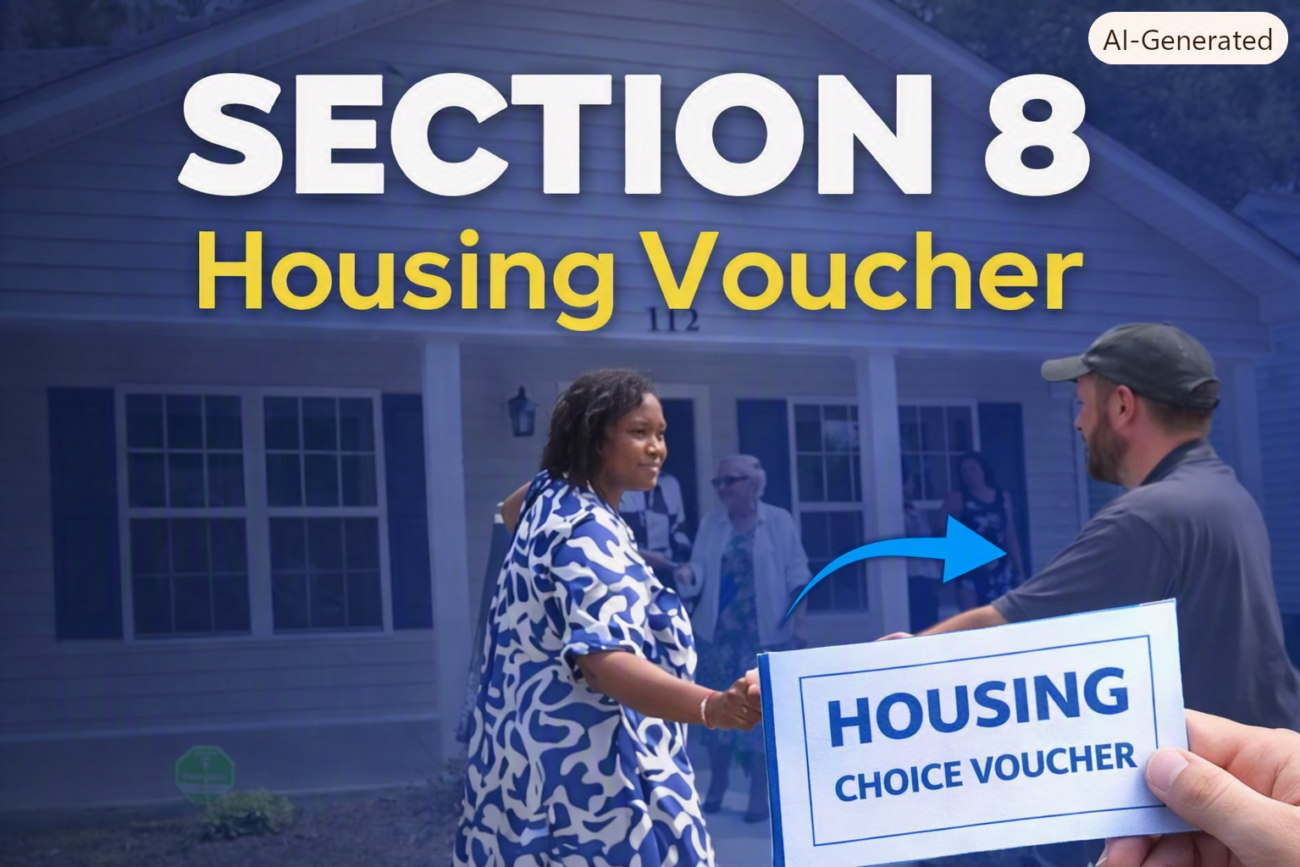
The Section 8 Housing Choice Voucher (HCV) program is a federal initiative funded by the U.S. Department of Housing and Urban Development (HUD) that helps very low-income families, the elderly, veterans, and people with disabilities afford safe, sanitary housing in the private market. Under this program, participants have the freedom to choose their own rental units, including single-family homes, townhouses, and apartments. The program pays a rental subsidy directly to the landlord, and the tenant covers the remaining balance.
Eligibility Requirements
To qualify for the Section 8 Housing Choice Voucher (HCV) program, applicants must meet four main federal eligibility requirements established by HUD: income level, family status, citizenship status, and history of evictions or criminal background.
Local Public Housing Agencies (PHAs) review documentation for all household members to verify eligibility before issuing a voucher.
1. Income limits (based on location and family size)
Your household’s total annual gross income is the primary factor in determining eligibility. HUD updates area-specific median income benchmarks annually. “Income limits vary from area to area, so you might be eligible at one PHA but not another,” according to Peoples Law.
PHAs classify income levels as follows:
Extremely low income (30% of the area median income): Households with income at or below 30% of their area’s median income receive priority. By law, PHAs must allocate “75% of all vouchers available in a given year to extremely low-income families,” as noted by Peoples Law.
Very low income (50% of the area median income): This is the standard maximum income limit for qualifying for a voucher.
Low income (80% of the Area Median Income): Households with incomes between 50% and 80% of the area median are rarely approved unless they qualify under specific local exemptions, such as receiving ongoing assistance or relocating through certain project-based programs.
2. Family status requirements
Applicants must meet HUD’s definition of “family,” which is very inclusive:
Family households: A group of people living together, with or without children.
Single-person households: Single adults, seniors (age 62 or older), or pregnant individuals.
Special populations: Individuals with documented physical or mental disabilities automatically meet the family composition criteria.
3. Citizenship and Immigration Status
Assistance is strictly limited to individuals with legal status.
Eligible status: Applicants must be U.S. citizens, U.S. nationals, or eligible immigrants (such as lawful permanent residents, refugees, and asylees).
Mixed-status households: If a family includes some members with legal status and others without, they may still receive assistance under the “mixed-family” rule. The PHA (Public Housing Agency) will prorate the voucher amount, covering only those family members who are eligible.
Identification: The head of the household must possess a valid Social Security Number (SSN) and sign consent forms for the release of federal data.
4. Background and criminal history checks
Having a criminal record does not automatically disqualify you, but PHAs conduct mandatory background checks:
Permanent denials: PHAs are federally required to permanently deny assistance to anyone convicted of producing methamphetamine in federal housing, or to anyone subject to a lifetime sex offender registration requirement.
Discretionary denials: PHAs may deny applications from individuals with recent records (generally within the last 3 to 5 years) involving violent crimes, drug-related criminal activity, or a history of alcohol abuse that threatens the safety of neighbors.
Housing debts: Applications will be denied for those who owe money to any PHA due to prior participation in a federal housing program, or for those who have been evicted from public housing within the last three years due to drug-related activities.
How Section 8 housing vouchers work
The Section 8 Housing Choice Voucher (HCV) program operates as a financial partnership between you, a private landlord, and a local Public Housing Agency (PHA). Instead of building public housing complexes, the government issues vouchers that allow you to choose and rent a standard home at market rates. The entire process follows a strict five-step cycle once your application is approved.
Voucher issuance and housing search
Once you reach the top of the waiting list and pass eligibility checks, the PHA issues you a voucher.
The timeframe begins: You generally have between 60 and 120 days to find an eligible rental unit.
Housing choice: You may choose an apartment, a townhouse, or a single-family home.
The landlord’s role: The landlord must be willing to participate in the Section 8 program and sign a contract with the PHA.
Rent and Safety Approvals
Before a lease is signed, the PHA (Public Housing Authority) must approve the specific property to ensure it meets federal standards.
Rent reasonableness: The PHA verifies that the rent is fair compared to unsubsidized units in the same neighborhood.
Housing Quality Standards (HQS): An inspector visits the property to verify that it is safe, sanitary, and structurally sound.
Payment standards: The total rent must align with the PHA’s “Payment Standard,” which is the maximum amount the PHA will subsidize for a unit of that size in your market.
Monthly rent breakdown
Once approved, the monthly rent payment is split into two parts:
Your share (30%): You pay exactly 30% of your household’s adjusted monthly gross income directly to the landlord. If you choose a unit priced slightly above the PHA standard, you may have to pay up to 40% of your income.
The PHA’s share (the subsidy): The PHA pays the remaining rent balance directly to the landlord each month using federal funds.
Annual recertifications
Vouchers are not a one-time approval; they require annual maintenance to keep the funding active.
Income verification: Each year, you must resubmit tax documents, pay stubs, and information about your assets. If your income increases, your share of the rent increases; if your income decreases, your share decreases.
Annual inspection: The PHA will re-inspect the rental property annually to ensure the landlord maintains safe living conditions.
Moving with your voucher (portability)
One of the biggest benefits of the Housing Choice Voucher is that it belongs to you, not the building.
Relocation: If you wish to move at the end of your lease, you can take your voucher with you to a new home with a different landlord.
Portability: You can even move to a completely different city or state, provided there is a local PHA in that area to administer your voucher.
Types of vouchers
The Section 8 Housing Choice Voucher (HCV) program includes various types of vouchers tailored to specific populations, housing needs, and living situations. Although all vouchers help pay for rent, they operate under different administrative rules.
1. Tenant-based vouchers
This is the most common type of voucher. Rental assistance is tied directly to the individual, not the property.
Mobility: You can choose any rental unit on the private market that meets program requirements.
Portability: If you decide to move, the financial subsidy moves with you to your new home, even if you relocate to another city or state.
2. Project-based vouchers (PBVs)
Project-based vouchers are tied directly to a specific housing unit or building complex.
Property linkage: A Public Housing Agency (PHA) enters into a contract with a landlord to subsidize specific units within their building.
Moving rules: If you move out of a project-based unit, you leave the housing assistance behind for the next tenant. However, after living there for one year, you can generally request priority to switch to a standard tenant-based voucher, provided one is available.
3. Special Purpose Vouchers (SPVs)
HUD allocates specific funds for populations facing severe or unique housing challenges. These vouchers often combine rental assistance with case management.
HUD-VASH (Veterans Affairs Supportive Housing):
Combines housing vouchers with case management and clinical services from the Department of Veterans Affairs (VA).
Specifically targets homeless veterans.
Family Unification Program (FUP):
Assists families for whom a lack of adequate housing is a primary factor in the imminent placement of children into out-of-home care (foster care) or in delaying children’s exit from such care.
Also assists young adults aged 18 to 24 who have aged out of the foster care system and are homeless or at risk of homelessness.
“Mainstream” Vouchers:
Exclusively for non-elderly persons with disabilities aged 18 to 61.
Helps individuals transition out of institutional settings or avoid homelessness.
“Foster Youth to Independence” (FYI) Program:
Provides housing assistance to young adults (under age 25) with a history in the foster care system who are facing homelessness.
Emergency Housing Vouchers (EHV):
Special vouchers reserved for individuals and families who are currently homeless, fleeing domestic violence, or at high risk of housing instability.
4. Section 8 Homeownership Vouchers
Some local Public Housing Agencies (PHAs) allow eligible families to use their voucher subsidy to pay a monthly mortgage instead of rent.
Requirements: Generally restricted to first-time homebuyers who meet specific employment and income requirements and complete a mandatory homeownership counseling course.
Application Process
The Section 8 application process is managed entirely at the local level through Public Housing Agencies (PHAs). Since the demand for rental assistance far exceeds available federal funding, applying requires carefully tracking open waiting lists and strictly submitting the required documentation.
Step 1: Find an open waiting list
You do not have to apply for assistance in the city where you currently live, but you must apply through a PHA that is actively accepting applications.
Checking status: Many waiting lists remain closed for years. You must monitor local PHA websites to find out when they open.
Lottery system: When a list opens, it may remain open for only a few days. PHAs often use a random lottery system to select who gets a spot on the list, rather than a first-come, first-served basis.
Locate offices: Use HUD’s official PHA (Public Housing Agency) contact directory to find housing agencies in your state or county.
Step 2: Submit the preliminary application
Generally, the initial application is free and is completed online or by mail. It requires basic information:
Household size: Total number of people who will live in the rental unit.
Gross income: Total annual income from all sources (wages, SSI, child support, pensions).
Local preferences: Indication of any local selection priorities that could speed up your progress on the waiting list.
Step 3: Local selection preferences
PHAs organize their waiting lists using a point system based on local preferences. Applicants who meet these criteria receive priority over others:
Homelessness: Individuals or families currently staying in shelters or in places not meant for human habitation.
Veterans: U.S. military veterans and their surviving spouses.
Local residency: Individuals who already live or work within the specific city or county jurisdictions covered by the PHA.
Domestic violence: Individuals fleeing abusive situations at home.
Step 4: The final eligibility interview
When your name reaches the top of the waiting list, the PHA will contact you to conduct a formal intake interview. You must provide physical documents verifying information for each household member:
Identity: Government-issued photo ID, birth certificates, and physical Social Security cards.
Proof of income: The last 4 to 6 consecutive pay stubs, tax returns, and official benefit award letters (e.g., from Social Security or TANF).
Assets: Recent bank statements for checking, savings, or investment accounts.
Step 5: Briefing session and voucher issuance
Once verification is complete and approval is granted, you must attend a mandatory briefing session.
Review of rules: The PHA explains family obligations, how to calculate the 30% of rent you are responsible for paying, and how to identify housing discrimination.
Voucher issuance: You receive the physical voucher, and the housing search period formally begins.
