
If you are struggling to make ends meet in Colorado, there are comprehensive assistance programs available to help you pay for housing, winter heating, and food. The fastest way to find a list of charitable organizations and immediate emergency assistance resources in your county is to call 2-1-1 or use the 211 Colorado online portal. This database covers all 64 counties and connects you directly with community food banks, emergency shelters, and local rent assistance programs.
Rent, Housing and Eviction Assistance
Colorado offers both state-level emergency funds and local nonprofit assistance, depending on your current legal and housing situation.
Colorado Emergency Rental Assistance (CERA)
The Colorado Emergency Rental Assistance (CERA) program, administered by the Colorado Department of Local Affairs (DOLA) Division of Housing, provides up to $10,000 or covers seven months of past-due rent to help tenants avoid eviction. Because state funds are limited, the program does not process applications on a first-come, first-served basis. Instead, it uses two distinct lottery pools to select individuals who can then complete a full application.
How CERA lottery systems work
You can enter your name into the system via two different pathways, depending on how close you are to being forced to leave your home.
- CARE Center daily lottery (For urgent evictions)
This pathway is strictly for tenants facing imminent court hearing dates or immediate eviction.
How to participate: You cannot register for this online. You must call the CERA CARE Center directly at (303) 838-1200.
Process: A representative will review your case over the phone. If you have the required emergency legal documents, they will manually add you to the daily random selection list.
Timeframes: Your name remains in the selection pool for two weeks. A computerized drawing takes place daily. If you are not selected after 14 days, you must call again to renew your spot.
- DOH monthly lottery (For general past-due rent)
This pathway is for standard rent debt situations where a formal court case has not yet been initiated.
How to participate: You must complete a brief online pre-application via the state portal during a designated 3-day window each month. For example, the monthly pre-application period is scheduled to open on Tuesday, September 8, 2026, at 10:00 a.m. and close on Thursday, September 10, 2026, at 5:00 p.m.
Process: Once the 3-day period ends, the state conducts a monthly lottery. If your name is selected, you will receive an automated email invitation granting you access to the Neighborly Portal to submit your complete proof of payment, payment records, and lease agreement.
Official Contact Information
All applications and support are managed through a centralized hub.
Phone/Text: (303) 838-1200 (Open Monday–Friday, 8:30 a.m. – 5:30 p.m. Mountain Time)
Web Portal: Colorado Division of Housing CERA page
Community Economic Defense Project (CEDP)
The Community Economic Defense Project (CEDP) is a Colorado-based non-profit organization that provides legal advocacy, emergency funds, and assistance in accessing benefits to prevent displacement. Originally founded as the COVID-19 Eviction Defense Project, the organization operates under an integrated model designed to address all aspects of economic hardship under one roof.
Free legal advocacy and court services
If you are facing an active legal dispute with a landlord, bank, or predatory agency, CEDP’s legal division (CED Law) offers free advice and in-court representation.
Eviction defense: Volunteer (pro bono) attorneys help tenants file official responses to court summonses, negotiate agreements to buy time, and represent residents at eviction hearings.
Mobile home communities: Specialized protection is offered to mobile home park residents fighting illegal lot rent increases or community rule violations by ownership companies.
Foreclosure guidance: They offer free legal clinics and guidance for homeowners facing bank foreclosure.
Appeals regarding predatory towing: CEDP actively helps Coloradans challenge illegal vehicle towing and hidden fees from impound lots.
Rental assistance and housing stability: CEDP serves as a lead guidance and intake partner for the rapid distribution of financial aid in Colorado.
Emergency cash disbursement: Short-term emergency payments for rent and mortgages are processed, designed to move faster than standard court eviction timelines.
Utility assistance: Case guidance is provided to resolve pending utility shut-off notices.
Public benefits enrollment: Dedicated specialists help households complete the necessary paperwork to access SNAP, state healthcare programs, and child care subsidies.
Pet deposit pilot program: For eligible tenants moving within Denver City Council District 10, the CEDP administers a program that provides a $300 pet deposit subsidy, ensuring families do not have to give up their pets to secure housing.
How to Contact the CEDP CARE Center
You can contact CEDP for immediate advice and to arrange for intake through several direct channels. All services are completely free of charge.
Central Helpline: Call or text (303) 838-1200. Hours of operation: Monday through Friday, 8:30 a.m. to 5:30 p.m. (Mountain Time).
Digital Intake Forms: You can complete the CEDP intake form for eviction or foreclosure cases online at any time to begin an automated review of your legal documentation.
Security Note: All official correspondence from the organization comes strictly from the @cedproject.org or @cedlaw.org domains. CEDP will never message you via WhatsApp or require payment of fees for its services.
Charitable Assistance for Lot Rent
If you are seeking help paying the rent for the lot where your mobile home is located, various religious organizations and church networks across Colorado offer direct financial assistance specifically to cover these costs. You do not need a standard apartment lease to qualify; community emergency assistance programs accept a valid mobile home park lot lease agreement along with a notice of past-due payment.
Since corporate increases in mobile home lot rents are a leading cause of displacement, major religious networks allocate emergency housing funds specifically for manufactured home communities.
- The Salvation Army Intermountain Division
- Society of St. Vincent de Paul (SVdP)
- Catholic Charities of Central Colorado
Utility and Energy Bill Assistance Programs
Heating and electricity costs can be offset through state initiatives and utility company programs designed for consumers.
Low-Income Energy Assistance Program (LEAP)
Colorado’s Low-Income Energy Assistance Program (LEAP) is a federally funded state initiative designed to help pay winter heating bills. It operates strictly as a seasonal winter program, accepting applications annually from November 1 through April 30. If your application is approved, LEAP sends a one-time financial benefit—ranging from $200 to $1,000—directly to your utility provider (e.g., Xcel Energy, Atmos Energy, or your local propane supplier).
2026–2027 Eligibility Requirements
To qualify for a seasonal utility payment, your household must meet three main criteria:
- Responsibility for heating costs: You must pay heating costs directly to an energy provider or pay for heating to your landlord as a specific part of your monthly rent.
- Legal status: At least one member of your household must be a U.S. citizen or a legal permanent resident.
- Income limit: Your household’s total gross monthly income cannot exceed 60% of the Colorado State Median Income (SMI).
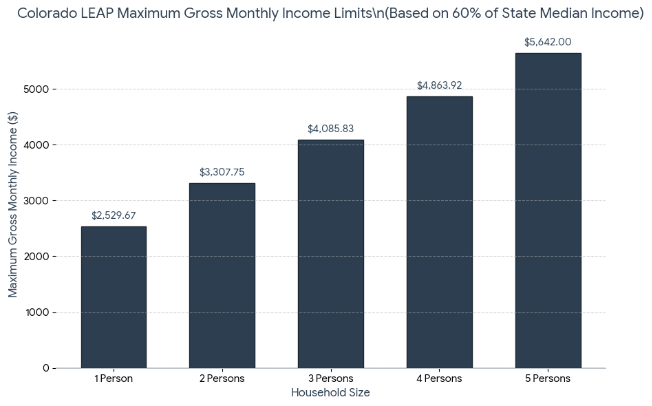
| Household Size | Maximum Gross Monthly Income Limit (60% SMI) |
|---|---|
| 1 Person | $2,950 / month |
| 2 People | $3,850 / month |
| 3 People | $4,760 / month |
| 4 People | $5,660 / month |
| 5 People | $6,570 / month |
How to apply
Applications are processed electronically or via paper forms submitted to local human services offices:
Online application: Submit documentation electronically directly through the Colorado PEAK portal.
By phone: Call the state helpline at 1-866-HEAT-HELP (1-866-432-8435) to request that a paper application be mailed to your home.
Required documents: You will need to upload your most recent utility bill showing your energy account number, proof of identity, and documentation of your gross income (such as pay stubs or benefit notification letters) from the past 30 days.
Crisis Intervention & Weatherization
The Crisis Intervention Program (CIP) and the Weatherization Assistance Program (WAP) are two independent, federally funded initiatives in Colorado; both help low-income households repair broken heating systems and permanently lower their monthly utility bills.
To access either of these programs, you must first apply for and be approved by Colorado’s Low-Income Energy Assistance Program (LEAP). LEAP approval automatically qualifies you for both CIP and WAP without the need to submit additional income documentation.
Local intake agencies
The Colorado Energy Office distributes WAP funds statewide through six regional agencies—either government entities or non-profits. You can contact your regional provider to check your status on the waiting list:
Denver Metro Area: Contact the Colorado Housing Connects network or your county housing authority.
Northern Colorado (Larimer/Weld): Managed by Longs Peak Energy Conservation.
Pikes Peak Region: Managed by the Energy Resource Center (ERC) in Colorado Springs.
Southern Colorado: Managed by the Energy Resource Center (ERC) in Pueblo.
Western Slope: Managed by Housing Resources of Western Colorado.
Energy Outreach Colorado
Energy Outreach Colorado (EOC) is an independent, statewide non-profit organization that provides year-round emergency financial assistance to residents struggling to pay overdue electricity, natural gas, or heating fuel bills.
Unlike the LEAP program (federally funded), which only accepts applications during the winter months, EOC operates year-round as a vital financial safety net. The organization pays emergency funds directly to your utility company to halt an active service disconnection or restore service. Monthly Bill Programs and Discounts
The EOC manages various initiatives designed to address both immediate utility-related emergencies and long-term affordability:
Bill Payment Assistance: The EOC makes a one-time cash payment directly to your electricity or gas account to settle overdue balances and prevent service shutoffs.
Percentage of Income Payment Plan (PIPP): To provide long-term relief, the EOC collaborates with the Colorado Public Utilities Commission and major utility providers. If you enroll in the PIPP, your monthly bill is set at a fixed, affordable percentage of your verified income (typically between 3% and 6%).
Free Community Solar Subscriptions: In select service areas (including Boulder and Denver), the EOC connects income-eligible renters and homeowners to community solar gardens. Participants receive clean energy credits on their monthly bills, allowing them to save 40% to 50% on annual electricity costs without the need to install rooftop panels.
How to Apply Via Local Intake Agencies
EOC does not process individual applications from its Denver headquarters. Instead, it distributes funds to a network of over 70 local charitable organizations, housing authorities, and family resource centers across the state’s 64 counties.
Use Energy Outreach Colorado’s official agency search tool to find the exact contact details for the charity managing funds in your ZIP code. Contact that local partner organization to schedule an intake appointment.
You must present an official government-issued photo ID, your most recent utility bill (showing your account number), and proof of your household’s gross income for the past 30 days.
Utility Affordability Credits
Utility affordability credits are monthly, percentage-based discounts applied directly to your energy bill; they aim to ensure that low-income households do not spend a disproportionate share of their income on gas and electricity.
In Colorado, these credits are strictly regulated by the Colorado Public Utilities Commission (PUC) and administered directly by the state’s major utility companies (investor-owned utilities).
Major Utility Affordability Programs in Colorado
If you qualify, your monthly bill amount is capped at a fixed percentage of your household income, and any accumulated outstanding balance may be systematically forgiven.
- Xcel Energy – Income-based affordability programs
- Black Hills Energy – Utility assistance in Colorado
- Atmos Energy – Sharing the Warmth
- Colorado Springs Utilities – LEAP and COPE
General Eligibility Requirements
To have these credits applied to your monthly bill, you must meet the following basic criteria:
Income Limit: Generally, your gross household income must be at or below 200% of the Federal Poverty Level (FPL) or 60% of the State Median Income (SMI).
Active account: The utility account must be active, correspond to a residence, and be registered in the name of an adult living at the address.
Categorical eligibility: If you have already been approved for LEAP, SNAP, SSI, or TANF benefits, most providers will automatically expedite your approval.
PTC Rebate
The Colorado Property Tax, Rent, and Heat Rebate (PTC) is a state-funded program administered by the Colorado Department of Revenue. It offers low-income seniors and individuals with disabilities an annual rebate of up to $1,112 to help cover housing and winter heating costs.
Since this is a rebate, you do not need to owe state taxes to receive this money. If you meet the requirements, the state will send the payment directly to you via direct deposit or a physical check.
How the Rebate Amount is Calculated
The PTC reimbursement amount is not a fixed rate for everyone. The state calculates your exact payment using a progressive scale based on your precise income.
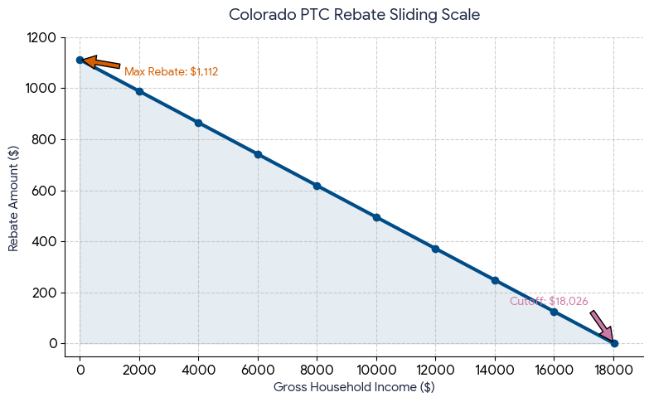
- Maximum benefit: Households with a total annual income close to $0 receive the maximum possible refund of $1,112.
- The phase-out effect: As annual income rises toward the upper limit ($18,026 for single filers), the calculated refund amount gradually decreases.
- Minimum benefit: Households right at the income limit will receive the minimum base refund guaranteed by the state, which is $25.
How to apply
You can apply for the PTC rebate completely free of charge. You do not need to file a full state income tax return to claim this specific benefit.
Online application (the fastest option): Submit your documentation electronically through the Colorado Department of Revenue’s official Revenue Online portal.
Application by mail: Download and print form DR 0104PTC, fill in the information regarding your rental or property tax history, and mail it to the Colorado Department of Revenue.
Required documentation: You must attach proof of income (such as Social Security Form 1099) and proof of housing expenses (such as a record of rent receipts, a copy of your lease agreement, or your county property tax bill).
Food banks, meals, and food vouchers
Food programs have undergone several significant changes regarding their administrative and eligibility rules.
SNAP (Supplemental Nutrition Assistance Program)
Colorado’s Supplemental Nutrition Assistance Program (SNAP)—formerly known as “food stamps”—provides monthly funds to eligible low-income households for purchasing food. Benefits are loaded electronically onto a Quest EBT (Electronic Benefit Transfer) card, which looks and functions like a standard debit card at checkout.
The Colorado Department of Human Services (CDHS) coordinates individual enrollment through county offices.
Online (the fastest option): Submit an electronic application at any time via the Colorado PEAK portal or use the official MyCOBenefits mobile app on your smartphone.
In person: Visit your local county Department of Human Services office to submit a paper application or use a public kiosk to apply. Required documents: Gather digital copies or clear photographs (taken with your phone) of your official photo ID, Social Security number, pay stubs from the last 30 days, and documents verifying your housing expenses (such as a rent payment record or a utility bill).
Immediate hunger relief
If you are facing a food crisis and need immediate hunger relief in Colorado today, free resources are available to provide hot meals, emergency food, and fresh produce without delay.
The fastest way to find a distribution center that is currently open is to call the Hunger Free Colorado helpline at 855-855-4626 (available Monday through Friday, 8:00 a.m. to 4:30 p.m.). Their bilingual staff connects callers directly with mobile food pantries, drive-through emergency distribution sites, and community meal sites near their specific zip code.
If you have a vehicle and need to quickly pick up a large amount of food without an appointment:
Food Bank of the Rockies Mobile Pantries: This network operates mobile truck routes that set up in the parking lots of schools, churches, and community centers across the state. They distribute free boxes containing fresh dairy, produce, and non-perishable items directly into your vehicle’s trunk. You can locate active weekly routes in real time using the Food Bank of the Rockies “Find Food” tool.
Joy’s Kitchen Food Rescue: This program rescues thousands of pounds of fresh food each week. They host a public food box distribution program every Thursday from 11:00 a.m. to 1:00 p.m. at 3632 Morrison Rd, Denver, CO 80219.
